Jumat, 25 Juli 2014

Married in Kuta Bali

Wedding moments become important for every human being. This becomes a perfect gateway to life in the world. To prepare it, not half-hearted a person will sacrifice many things, such as wealth and time. Preparing for a wedding is a must for everyone. They need to do a proper preparation for that happy day hold. The desire to obtain beautiful memories during the wedding ceremony is the dream of every person. One of the most preferred place to be married people are married in Kuta Bali.

For a wedding in Bali, at this time is not something that is hard to do. You live contact to a wedding organizer and specify your stay according to your budget. The location is a favorite so far is the Kuta area. But despite it all, every second of your wedding will be more meaningful if they can memorialized appropriately and with a touch of beauty through the camera lens.

You can choose where you want to get married, such as hotels, villas, off the coast, chapel. In Bali you will be pampered by the beautiful view of the sea, very green surroundings with a comfortable atmosphere. So that Bali is a very interesting place to be the happiest memories of your wedding. No wonder so many people come to Bali to capture the wedding ceremony on the island of Bali is very beautiful.

Kamis, 05 Juni 2014

Penglipuran

Penglipuran Traditional Village is located in Bangli district within 45 km from the city of Denpasar, the village has also become customary this attraction is very easy to find, because it is situated on Main Street Kintamani - Bangli. This village is one of the rural areas in Bali which has a regular order of the traditional village structure, a blend of the traditional order with plenty of open space beautiful landscaping make this village makes us feel the nuances of Bali yore. The advantages of a traditional village Penglipuran compared to other villages in Bali is, the front part of the uniform of similar homes and villages until the end of the main part of the village downstream. Neatly arranged in such a village where the main area located higher and further dropped to stricken downstream. In addition to forward the same shape, uniformity also form the existence of material to make the house. Soil-like material for the walls and for the roof is made of bamboo for building penyengker and around the village. Characteristic of the village lies in angkul - angkul (gate) houses a uniform population. Besides angkul-angkul uniform, the village located about five kilometers north of Bangli also has a number of other unique customs and traditions. One of them, the restrictions for her to take more than one or polygamy.

Nyepi Day and Festival of Ogoh - Ogoh

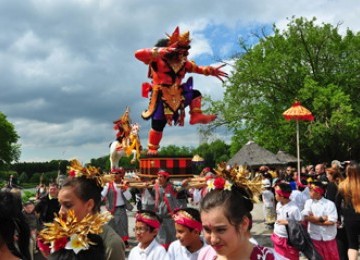
Nyepi Day is a feast day Hindus, who celebrated each New Year Saka. This feast is believed to be on the purification of the gods - gods. Prior to celebrate Nyepi, Hindus usually do Melasti ceremony conducted on the shore, which aims to rid yourself of all leteh (Dirty). After the ceremony pecaruan (Tawur), and pengerupukan. Where at the time pengerupukan Hindus rallied ogoh - ogoh around the village. Ogoh - ogoh is one of the cultural arts of Bali, where ogoh - ogoh Bhuta Kala illustrates kepridadian (Giant). Besides embodied as a giant personality, ogoh - ogoh often manifested in the form of beings - beings in heaven and hell. The parade ogoh - ogoh is the art of creativity and motivation of young artists. Where here the youth to channel their talent and art in the making of ogoh - ogoh, manufacture ogoh - ogoh will cost up to tens of millions. Making ogoh - ogoh is already a tradition of Hindus or people of Bali to welcome the new year saka. The presence of ogoh - ogoh be one complementary rituals Nyepi. Ogoh - ogoh in pawaikan day before Nyepi. Ogoh - ogoh in procession around the village in the afternoon which aims to drive the Bhuta Kala, so as not to interfere with the implementation of Nyepi day the next day.

The Balinese tradition


Bali Island one of the small islands known by various levels of society and even abroad because of the culture, customs and traditions of its natural beauty. Factors that make this area very attractive to pengun ¬ jung is inseparable from the attitude of public attitudes suave to every visitor, it is no wonder that one of the area into a tourist destination abroad domistik maunpun. In Bali, the Hindu culture and religion into two phenomena in a single reality. Transforming culture toward religious traditions happen so beautifully in Hinduism room that smelled of cultural and religious harmony. Cultural phenomena appear as expressions of truth, harmony, purity and happiness. The word banjar bali no term or can be referred to as a village. Perbentukan Banjar is a unity - social unity based on dikepalahi Banjar region by serving as a banjo Klian concerning all matters in the field of social and religious life, but often also have to solve the problems of indigenous ground covers, and the things that its administration. Value - the value of culture that unites and mengharmonisan lives of Bali. Bali has a lot of various ancestral cultural heritage which is still firmly embedded in the community and Bali itself, is also a variety of unique traditions that still adhered to in the community. Culture and tradition that is has its own characteristics in each region, village or banjar in Bali. Has a wealth of diverse cultures is certainly a public duty to preserve it, not crushed or shifted due to the influence of today's modern world. Among cremation, omed - omedan, pandanus war, megibung, burial in Trunyan, and many others. With this tradition bali people can keep their culture has.

Mask Sidakarya

In written sources that reveal the history of tradional Sidakarya is "Papyrus Bebali Sidakarya" which is a collection of Ida Rauh of Mount Gede Nyoman Biau, Muncan village, Karangasem. In summary told that Ida Dalem Sidakarya is wulaka Brahmin descent from the Sakya called Brahmin Rivet or Rivet. Rivet Brahmin called because it comes from the area Keling, East Java. Brahmana Keling was the son of Dang Hyang Cinnamon, grandson of the MPU Candra, kumpi from MPU Bahula and great-grandchildren of the MPU Beradah. Narrated, Brahmana Keling go to Bali. Not narrated journey from Java to Bali, he arrived at the palace Gelgel, Klungkung to see the king. Arriving at the palace Gelgel, Sultan Gelgel Waturenggong very quiet because the King was in Besakih prepare for the ceremony. Arriving at Besakih, Brahmin Rivet met with tradional Waturenggong and Dang Hyang Nirartha. Rivet Brahmins into the Besakih unseen. Because so tired, he went to shrines and rest a while. Not long after came Dalem Waturenggong and see that there are people with shabby clothes. Unfortunately this is not recognized as a Brahmin brother because he saw his clothes were ragged people think crazy, even expelled by force. At that time, the Brahmin Rivet could say that it condemns Pastu: Wastu astu system, the work undertaken Sidakarya tan (not successful), dryness of the earth, the people kegeringan, sarwa gumatat-gumitit ngrubeda. After saying the curse, he headed Sidakarya village. On one night, meditating in tradional Waturenggong Besakih and get directions Ida Batara that he has sinned cast out your own. After getting instructions (pawisik), directly next day Ida Dalem calling its prime minister Arya Kepakisan (Gusti Agung Petandakan) and call the other Patih as the foundation Arya, Arya hose and others, including the retainer to hold a hearing. After getting instructions (pawisik), directly next day Ida Dalem calling its prime minister Arya Kepakisan (Gusti Agung Petandakan) and call the other Patih as the foundation Arya, Arya hose and others, including the retainer to hold a hearing. In the trial without deciding the agenda for immediate pick Brahmin who never expulsion Rivet, Rivet Brahmin pickup group went to Badanda State. Arriving at the party Badanda State Meet with the group deliver to Brahmin Rivet's adoration for forgiveness once he had come to tell about the presence of the Brahmins. Arriving at Rivet Brahmin Besakih, Dalem Waturenggong pleading mercy that restored the island, no disasters and pests. Similarly, work or religious ceremony can take place properly, with appointments will receive a Brahmin Rivet as a brother. After all the state can be restored as expected, then the tradional Waturenggong acknowledge Rivet Brahmins as his brother who was given the title Brahmin Sidakarya Sidakarya or sarongs.

Tooth filing ceremony in Bali


 Besides ngeben most unique ceremony in Bali is mepandes / metatah (cutting teeth), mepandes ceremony is one ceremony to human yadnya. Where in this ceremony 6 including canine teeth in a miser or flattened. This ceremony has become a tradition of Hindus in Bali, all Bali teen bound to run into this. How metatah not a way to cut, but rather flattened or filed. Who do do pengikiran called sangging, before carving, Sangging will recite the spell first. When before and after the chisel in chisel teeth will be in touch with the red ruby ​​ring as a symbol of protection. Indeed tooth filing ceremony is the duty of parents to children - children, because its meaning is rightly parents give good advice so ugly nature of his inner control. The ceremony is usually combined with cutting teeth Sewala Ngeraja ceremony. Ngeraja Sewala a thanksgiving ceremony for children who reach adulthood, leave childhood into adulthood. Mepandas very abstinence ceremony conducted by a woman who is pregnant. natural implementation, tooth filing ceremony in Bali is not seserem his name, does not mean his teeth cut teeth cut but only filed flat, 6 rows of upper teeth including canines, as a symbol of cleansing bad traits described above. In general, this unique event coupled with other religious ceremonies such as cremation or marriage. And usually carried out together with relatives who have stepped up and who have never done this ceremony of course. Indeed tooth filing ceremony in Bali is the duty of parents to their children, because their meaning is rightly parents give good advice so ugly traits that exist in children can be controlled. One of the restrictions for participating in this event is the women who are pregnant. And in the particular occasion of this ceremony can be carried in bulk. (Together in one village).